

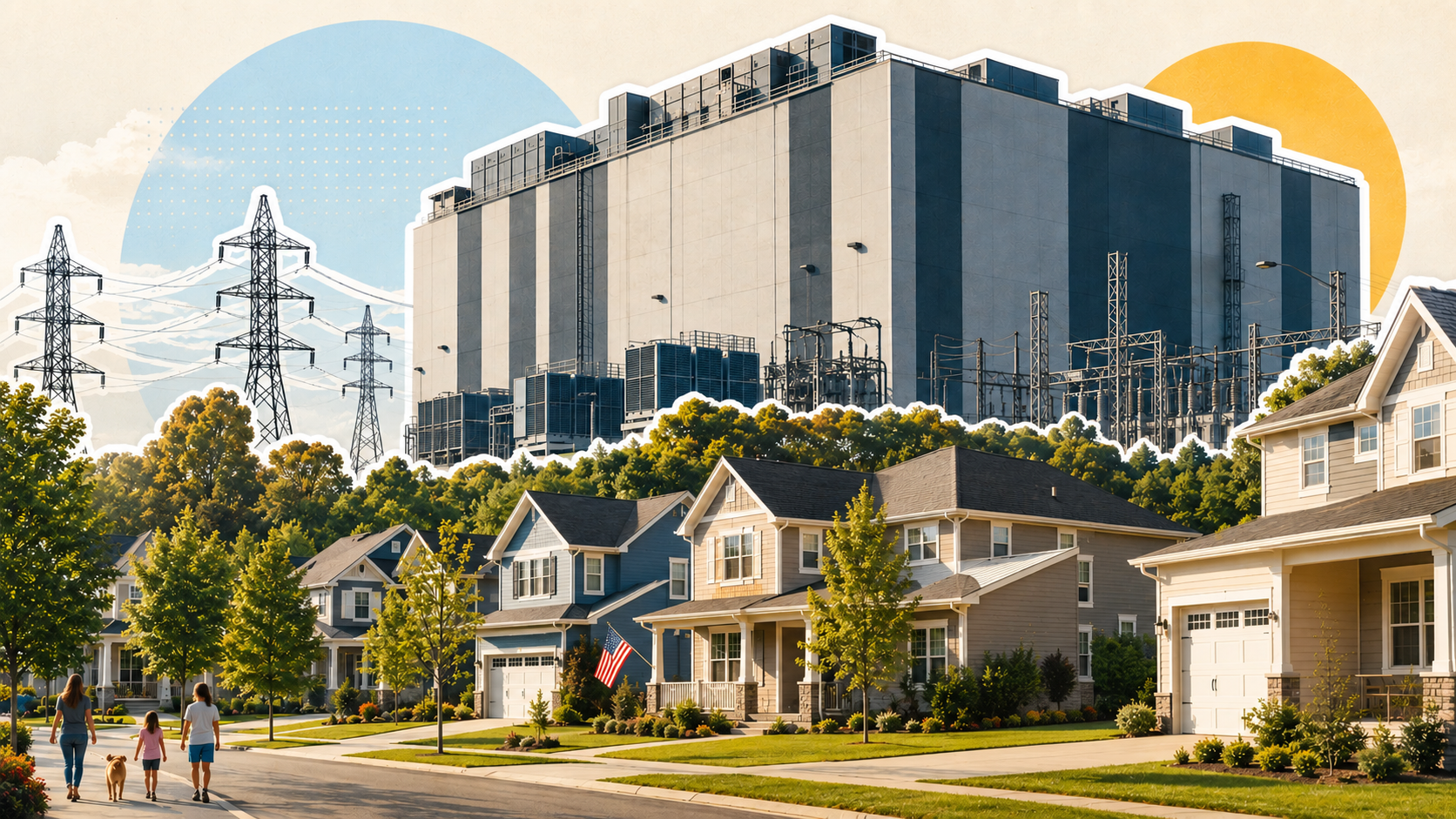
AI is changing a lot more than how we work, and its latest impact might be showing up in your backyard.
The massive growth of AI has fueled a data center building boom across the country, and increasingly, those facilities are showing up near places people live. According to new research from Realtor.com, the share of U.S. home sales happening within five miles of a large data center has more than doubled since 2018. For this study, Realtor.com defines a large data center as a facility with at least 50 megawatts of power capacity.
If a massive data center opened near your neighborhood, you might assume home values would take a hit. So far, that hasn't happened. Realtor.com compared home prices in 43 ZIP codes that received large data centers with similar areas that didn't and found no statistically significant difference in how prices performed.
Data Center Proximity
More U.S. home sales are happening near large data centers
Home prices say one thing. Buyers may say another.
In a May 2026 Redfin/Ipsos survey, 53% of Americans said they opposed an AI data center being built in their neighborhood, compared with 34% who supported one. Data centers received more opposition than any other type of development included in the survey.
There are already signs of that sentiment making its way into real estate decisions. A Northern Virginia Realtor told Redfin that a buyer recently asked him, without being prompted, to make sure there wasn't a data center planned near a home she was considering. Another client told him after moving into a community with several data centers that they probably would have chosen a different location if they had known how many were nearby.
Buyer Sentiment
Would Americans want an AI data center in their neighborhood?
The concerns aren't hard to understand. Depending on the project, nearby homeowners may be looking at massive industrial buildings, cooling equipment, backup generators, new substations and the possibility of persistent noise. Those impacts vary considerably depending on the facility, its design and how far it sits from residential property.
It's a fair question, and it gets at the gap between what the housing data shows today and how individual buyers make decisions. A study can tell us that home prices haven't declined across dozens of ZIP codes, but it can't make a buyer stop caring about what's behind the backyard.
You don't have to live next to one to be affected
The physical footprint of AI gets much bigger once you look beyond the data center itself. Modern data centers use an extraordinary amount of electricity. Lawrence Berkeley National Laboratory estimates they could consume nearly 12% of all U.S. electricity by 2030, and supplying that kind of demand can require new substations, transmission lines and other infrastructure well beyond the data center property.
The Bigger Footprint
The real estate impact can extend miles beyond the facility
What this looks like in Georgia
Georgia Power is building a new 35-mile, 500-kV transmission line southwest of Atlanta as part of a much larger expansion of the state's electrical grid. The utility says the line isn't being built for any single customer, but GPB reported that data centers are driving 80% of the growth in electricity demand Georgia Power is currently seeing.
Building the line requires roughly 300 property acquisitions. Some homeowners are losing portions of their land to new transmission easements, while some homes are being purchased entirely. One family learned that the new right-of-way would take out their backyard pool. If Georgia Power and a property owner can't reach an agreement on land needed for the project, eminent domain can ultimately become part of the process.
That puts the real estate impact of the AI boom in a very different perspective. A homeowner doesn't necessarily need to see a data center from their kitchen window for the infrastructure supporting one to change their property.
There are real benefits on the other side of the equation. Data centers can bring enormous private investment and tax revenue into a community, along with construction jobs and some permanent employment. Redfin's analysis of Northern Virginia, the country's largest data center market, found that taxes on data center equipment are likely helping fund increased education spending there.
So what does all of this mean for home values?
Right now, the most accurate answer is that we don't know what the long-term effect of the current data center boom will be. The best housing research we have hasn't found a measurable decline in nearby home prices, and there's no evidence to support telling homeowners that a proposed data center will automatically tank their property value.
But today's AI-driven expansion is happening quickly, and Realtor.com's home-price study only followed communities for two years after a large data center became operational. At the same time, more than half of Americans in Redfin's survey said they don't want one built in their neighborhood, and we're starting to see Realtors encounter that concern directly from buyers.
Frequently Asked Questions
Do data centers lower property values?
Current research has not found a statistically significant decline in nearby home prices after large data centers open. The available research is still relatively short-term, so it is too early to say there can never be an effect.
Are data centers noisy?
They can be. Cooling equipment and mechanical systems can produce continuous sound, while backup generators create intermittent noise. How noticeable it is depends on the facility design, distance, barriers and local noise requirements.
Can data center infrastructure affect property owners farther away?
Yes. Large electricity demand can require new substations and transmission lines. Those projects may cross private property and can involve easements, property acquisition and, in some cases, eminent domain.
Sources & Further Reading


.svg)